
Every structure – whether a two-story house or a six-lane expressway – ultimately rests on the ground beneath it. The strength of that ground, its composition, and its behavior under load determine whether a building stands for a century or develops dangerous cracks within a decade.
Yet soil testing is one of the most frequently skipped steps in construction, especially in smaller projects. This article explains why that is a mistake that can cost you far more than the test ever would.
Why Soil Testing is Mandatory Before Any Construction Project
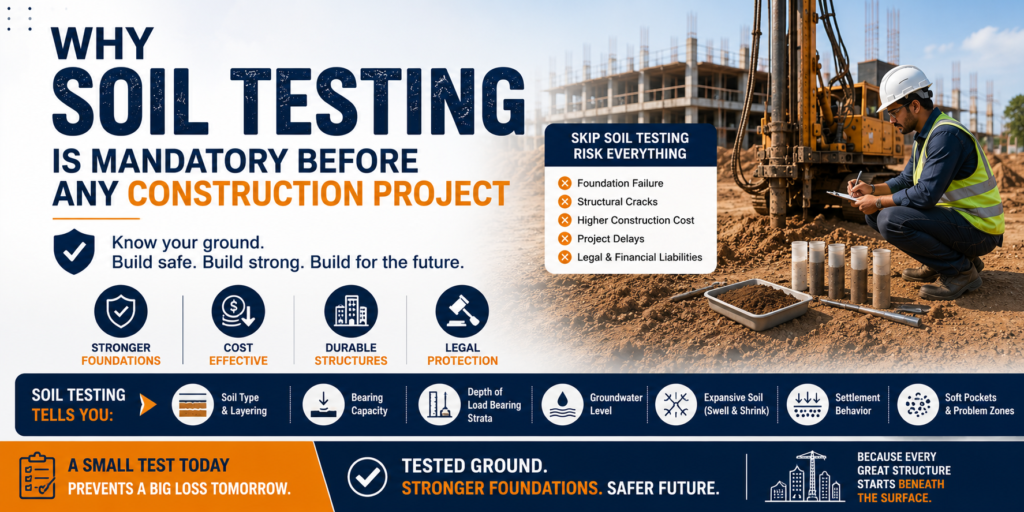
What Does Soil Testing Actually Tell You?
A geotechnical investigation is not simply a formality. It tells your structural engineer:
- The type and layering of soil beneath the site
- The bearing capacity of the soil – how much load per square meter it can safely support
- The depth at which stable, load-bearing soil or rock is found
- Whether the soil is expansive (swells when wet, shrinks when dry – which causes foundation cracking)
- Whether groundwater is present and at what depth
- The settlement behavior – how much the soil will compress under the weight of the structure
- Whether the site has any soft pockets, filled areas, or problem zones
Without this information, a structural engineer is designing a building on assumptions. That is an enormous risk.
What Happens When Soil Testing Is Skipped?
The consequences of inadequate geotechnical investigation range from expensive to catastrophic:
- Foundation failure — Structures built on poorly investigated soil frequently develop differential settlement, where different parts of the building sink at different rates. This causes severe cracking and can make buildings unsafe.
- Over-designed foundations — Without soil data, conservative engineers design deeper, costlier foundations ‘just in case.’ You pay for soil investigation either before the building is designed, or through the extra concrete and steel in an over-engineered foundation.
- Legal liability — For commercial and government projects, the absence of a soil investigation report is a documentation failure that can invalidate insurance, lead to contract disputes, and create personal liability for project owners and engineers.
Which Projects Absolutely Require Soil Investigation?
- Any structure with isolated or combined footings, raft foundation, or pile foundation
- All highway, road, and expressway projects — CBR testing at every kilometre is standard practice
- Bridges, flyovers, and ROBs — deep foundation design is impossible without SPT data
- All government and NHAI projects — mandatory as per IS and MoRTH specifications
- Industrial projects with heavy machinery foundations
- Any building above G+2 or with a basement
The Typical Tests in a Geotechnical Investigation
A standard soil investigation for a building project includes:
- Borehole drilling to adequate depth (usually 1.5× the width of the foundation below the footing level, minimum)
- Standard Penetration Test (SPT) at regular depth intervals
- Collection of soil samples for laboratory testing
- Laboratory tests: grain size analysis, Atterberg limits, specific gravity, moisture content, compaction, and bearing capacity
- A final Geotechnical Investigation Report with bore logs, soil profiles, and foundation recommendations
Conclusion
Soil testing is not an optional extra. It is the foundation of good foundation design. A comprehensive geotechnical investigation typically costs a fraction of one percent of any significant construction project budget – but the information it provides protects the entire investment.
ADS Labtech provides NABL accredited geotechnical investigation services in Ghaziabad, NCR, UP, and Uttarakhand. Our experienced soil engineers handle borehole drilling, field testing, and laboratory analysis – delivering complete reports that your structural consultant can rely on.